 Skip to content

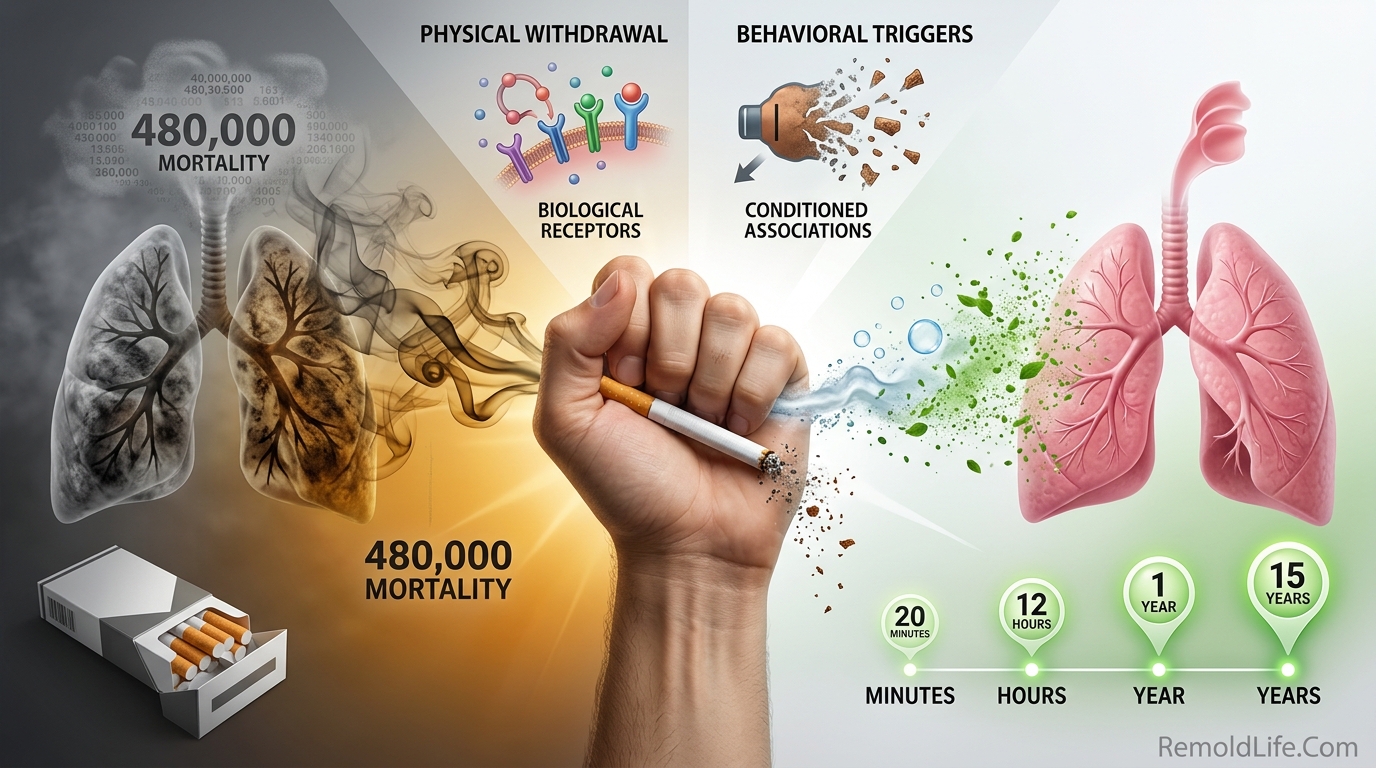

Knowing how to quit smoking effectively is the most important health decision many smokers will ever make. Tobacco smoking remains the leading preventable cause of death in the United States, responsible for approximately 480,000 deaths annually according to the Centers for Disease Control and Prevention. Yet quitting is genuinely difficult — nicotine is one of the most addictive substances known, and cigarettes are engineered to deliver it efficiently.
This guide focuses on what actually works — the methods with the best evidence behind them, what realistic timelines look like, and how to handle the most challenging moments.
Why Quitting Is Hard: Understanding Nicotine Dependence
Nicotine addiction has two distinct components that both need to be addressed:
Physical dependence — your brain has adapted to the presence of nicotine by adjusting receptor levels and neurotransmitter activity. When nicotine is removed, withdrawal symptoms occur: irritability, difficulty concentrating, increased appetite, anxiety, restlessness, and intense cravings.
Psychological and behavioral dependence — smoking is deeply embedded in daily routines and emotional states. The morning cigarette with coffee, smoking after meals, the cigarette during stress — these associations become powerful conditioned triggers independent of physical nicotine need.
Effective cessation strategies address both. Methods that only address one — nicotine replacement without behavioral support, or behavioral support without addressing withdrawal — have lower success rates than approaches that tackle both simultaneously.
Success Rates: What the Evidence Shows
Before choosing a method, it’s worth understanding what realistic success looks like. Research on smoking cessation consistently shows:
- Unassisted “cold turkey” quitting: approximately 3–5% long-term success
- Nicotine replacement therapy (NRT) alone: approximately 10–15% success at 12 months
- Prescription medication alone (varenicline/Champix): approximately 20–25% success at 12 months
- Combination NRT: approximately 15–20% success
- Medication + behavioral support: approximately 25–35% success at 12 months
These numbers feel discouraging — but they don’t mean most people never quit. Most successful quitters made multiple attempts before their final quit. The American Cancer Society notes that on average, smokers make 8–10 attempts before quitting permanently. Each attempt is not failure — it’s valuable learning about what works and what doesn’t for you specifically.
Method 1: Nicotine Replacement Therapy (NRT)
NRT provides controlled doses of nicotine without tobacco’s thousands of harmful chemicals. This reduces withdrawal severity while allowing the behavioral aspects of addiction to be addressed separately.
Available NRT forms:
| Form | How It Works | Best For |
|---|---|---|
| Nicotine patch | Continuous slow-release through skin | Steady background nicotine level; simple to use |
| Nicotine gum | Quick delivery when chewed correctly | Managing acute cravings on demand |
| Nicotine lozenge | Dissolves in mouth; fast delivery | Acute cravings; discreet |
| Nicotine inhaler | Mimics hand-to-mouth habit | People who miss the behavioral aspect of smoking |
| Nicotine nasal spray | Fastest nicotine delivery of NRT options | Heavy smokers with severe cravings |
Combination NRT — using the patch (for steady baseline nicotine) plus a fast-acting form (gum, lozenge, or inhaler) for acute cravings — produces better results than either form alone. Research published in BMJ found that combination NRT significantly outperformed single-form NRT across multiple studies.
NRT is available over the counter in the US without prescription and is considered safe for most people including those with cardiovascular disease (contrary to older medical caution). The National Institutes of Health recommends NRT as a first-line treatment.
Method 2: Prescription Medications
Varenicline (Chantix/Champix)
Varenicline is a partial nicotine receptor agonist — it reduces withdrawal symptoms by mildly activating nicotine receptors while simultaneously blocking the pleasurable effects of cigarettes. This dual mechanism makes it uniquely effective.
A Cochrane Review (the gold standard of medical evidence synthesis) found varenicline more effective than both bupropion and NRT for smoking cessation. It roughly triples the likelihood of quitting compared to placebo.
Practical notes: Starts 1–2 weeks before the quit date. Taken for 12 weeks, often extended to 24 weeks for maximum benefit. Requires a prescription. Side effects can include nausea (most common), vivid dreams, and headaches. Prior warnings about psychiatric side effects have been substantially revised — the FDA updated labeling in 2016 after large trials showed psychiatric risk was lower than initially indicated.
Bupropion (Wellbutrin/Zyban)
An antidepressant that also reduces nicotine cravings through dopamine and norepinephrine pathways. Less effective than varenicline overall but useful for smokers who also have depression or for whom varenicline is contraindicated.
Discuss both options with your doctor. The U.S. Preventive Services Task Force recommends medication for all adults who smoke — it’s underused relative to its effectiveness.

Method 3: Behavioral Support and Cessation Programs
Medication and NRT address the physical component. Behavioral support addresses the habits, triggers, and psychological patterns.
Counseling and quitlines: Phone counseling through state quitlines has strong evidence — the 1-800-QUIT-NOW national quitline connects to free coaching support. Research consistently shows counseling significantly improves cessation rates when combined with NRT or medication.
Cognitive behavioral therapy (CBT) for smoking: CBT helps identify triggers, develop coping responses, challenge automatic thoughts that lead to smoking, and build new behavioral routines that don’t include cigarettes.
The SmokefreeTXT program: Free text message support from the SmokeFree.gov program — evidence-based automated support available 24/7.
Apps: Smoke Free, QuitNow!, and Kwit all have research support for improving cessation outcomes through tracking, craving management tools, and motivational content.
Setting Your Quit Date and Plan
Choosing a specific quit date — rather than vaguely intending to quit “soon” — dramatically improves success rates. Research shows commitment to a date, preparation in advance, and environmental changes together create conditions for success.
Preparation steps in the week before your quit date:
- Tell people you’re quitting — social accountability reduces relapse rates. The social support aspect genuinely matters.
- Remove all cigarettes, lighters, and ashtrays from home, car, and workspace — environmental cues trigger cravings powerfully.
- Identify your triggers — stress, alcohol, specific times of day, social situations. Make a plan for each.
- Stock up on oral substitutes — carrots, gum, water, toothpicks — for the hand-to-mouth habit.
- Start NRT or prescription medication before your quit date as directed.
- Plan your first week — reduce alcohol significantly (a powerful relapse trigger), avoid situations strongly associated with smoking early on.

Managing Cravings in the First Weeks
The first 2–4 weeks are the hardest. Withdrawal peaks in the first 72 hours and typically substantially improves within 2–4 weeks. During this period:
The 4 D’s technique:
- Delay — most cravings peak and pass within 3–5 minutes. Waiting out the craving without acting on it causes it to subside.
- Deep breathe — slow breathing activates the parasympathetic nervous system and reduces the physiological urgency of the craving.
- Drink water — sipping cold water through a straw mimics the oral aspect of smoking and supports craving management.
- Do something else — physical distraction interrupts the craving cycle. Walking, texting someone, doing something with your hands.
What Happens to Your Body When You Quit
Understanding the timeline of physical recovery provides motivation during difficult moments:
| Time After Quitting | What Happens |
|---|---|
| 20 minutes | Heart rate and blood pressure begin to drop |
| 12 hours | Carbon monoxide levels in blood return to normal |
| 2–12 weeks | Circulation improves; lung function increases |
| 1–9 months | Coughing and shortness of breath decrease; cilia regrow |
| 1 year | Risk of heart disease halved compared to a smoker |
| 5 years | Stroke risk reduced to that of a non-smoker |
| 10 years | Lung cancer risk halved compared to a smoker |
| 15 years | Heart disease risk equivalent to a non-smoker |
Source: American Cancer Society
Handling Relapse
A relapse — smoking after a quit attempt — is extremely common and should be expected as a possibility rather than treated as evidence that quitting is impossible for you.
If you relapse: don’t catastrophize. Analyze what happened — what was the trigger? What could you do differently? Use the information and try again. Research consistently shows that each quit attempt increases the likelihood of eventual success, because each attempt teaches you more about your specific triggers and vulnerabilities.
The decision to smoke again is not failure — it’s information. Apply it to your next attempt.
Frequently Asked Questions
Vaping is significantly less harmful than smoking cigarettes — but it’s not harmless, and the long-term health effects remain incompletely understood. As a cessation tool, some evidence supports it: a 2019 study in the New England Journal of Medicine found that a nicotine e-cigarette group had higher abstinence rates than an NRT group at 12 months. However, a majority of those who quit smoking using vaping continued to vape. Current medical guidance from the NHS and others supports vaping as a cessation aid while acknowledging it shouldn’t be the endpoint — the goal is nicotine independence.
Many people gain some weight — typically 4–10 pounds on average — in the first months after quitting. This results from nicotine’s metabolism-boosting effect reversing, and from increased appetite. This weight gain is far less harmful than continuing to smoke, and tends to stabilize. Anticipating it and modestly increasing physical activity during the cessation period helps minimize it.
Physical withdrawal peaks in the first 72 hours and substantially improves within 2–4 weeks. Psychological cravings — triggered by associated situations — can persist for months but typically decrease in frequency and intensity over time. Most ex-smokers report that cravings become occasional and manageable rather than constant within 3 months.
The evidence for both is weak. Some small studies show modest benefit from hypnotherapy; most larger, better-designed studies show no significant effect beyond placebo. Acupuncture similarly lacks strong evidence for smoking cessation specifically. Neither is harmful, and if someone finds them personally helpful as part of a broader cessation approach, that’s fine — but they shouldn’t replace evidence-based methods.
No. The benefits of quitting begin within minutes and accumulate over years regardless of how long you’ve smoked. Quitting at 60 still meaningfully reduces cardiovascular and cancer risk compared to continuing. The benefits are never zero, and it’s never too late to experience them.

Final Thoughts
Quitting smoking is genuinely hard — and being honest about that is important. Nicotine is a powerful addiction with decades of behavioral reinforcement behind it for most long-term smokers. The difficulty of quitting is not a personal weakness — it’s a reflection of the substance’s addictive properties.
What makes the difference between those who eventually quit and those who don’t is usually not willpower — it’s using the right tools (medication and/or NRT), getting support, and treating relapses as information rather than evidence of impossibility.
The investment of difficulty is worth it. The health, financial, and quality-of-life benefits of being smoke-free are among the most significant any single behavior change can produce.
For related health reading, how to manage stress and anxiety addresses one of the most common smoking triggers, and how to boost your immune system covers the recovery that begins once smoking stops.
Sources:
- Centers for Disease Control and Prevention — Smoking and Tobacco Use: https://www.cdc.gov/tobacco/
- American Cancer Society — Guide to Quitting Smoking: https://www.cancer.org/
- U.S. Preventive Services Task Force — Tobacco Cessation Recommendations: https://www.uspreventiveservicestaskforce.org/
- SmokeFree.gov — Cessation Tools and Resources: https://www.smokefree.gov/
- Hartmann-Boyce J et al. — Nicotine Replacement Therapy. Cochrane Review (2018)
- Cahill K et al. — Varenicline for Smoking Cessation. Cochrane Review (2016)
- Hajek P et al. — E-Cigarettes vs NRT. New England Journal of Medicine (2019)