 Skip to content

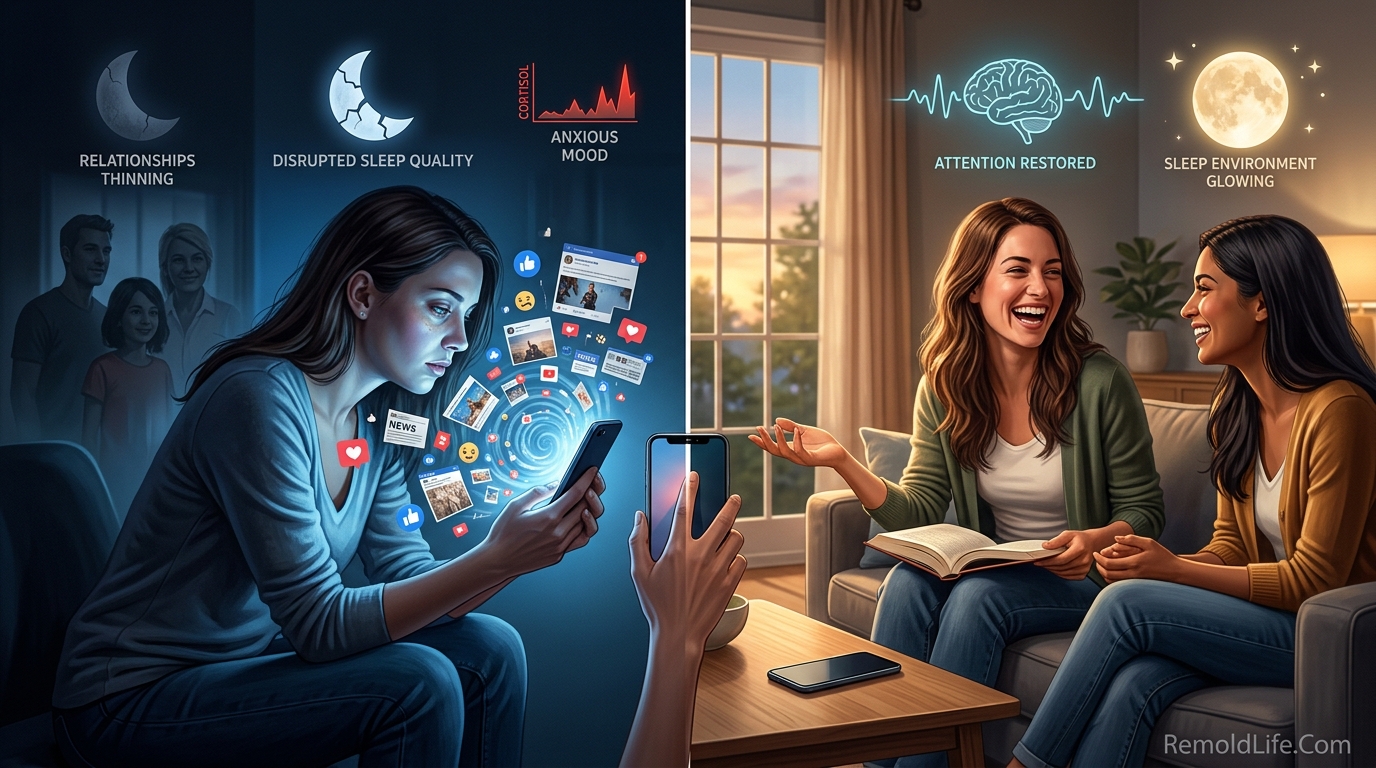

A digital detox — intentionally reducing the time you spend on screens, particularly phones and social media — has become one of the most discussed lifestyle interventions of the 2020s. Not because screens are inherently harmful, but because the way most people use them in 2026 has fundamentally outpaced any reasonable personal boundaries.
The average American adult spends approximately 7 hours per day looking at screens, according to data from Statista. That includes work screens, but a significant portion is recreational — social media, streaming, news cycling, and passive scrolling. Understanding what that’s doing to your attention, sleep, mood, and relationships — and what to do about it — is what this guide covers.
What Screen Time Is Actually Doing
The concern about excessive screen time isn’t moral panic — it’s increasingly well-supported by research across several specific mechanisms:
Sleep disruption: Blue-wavelength light from screens suppresses melatonin production, pushing the sleep signal later. Research published in the Proceedings of the National Academy of Sciences found that evening device use delays sleep onset, reduces REM sleep, and increases daytime fatigue — effects measurable even with blue-light filters applied.
Attention fragmentation: Social media platforms and notification systems are specifically engineered to interrupt sustained attention. Research by Microsoft found that the average human attention span has shortened significantly over the past two decades — a trend correlated with increased digital device use. Frequent notification-checking trains the brain toward constant context-switching and away from deep focus.
Mood effects: Multiple large studies have found associations between heavy social media use and increased anxiety, depression, and social comparison. A 2022 study published in PLOS ONE found that even reducing social media use to 30 minutes per day produced significant reductions in anxiety and depression compared to a control group — detectable within three weeks.
Reduced presence: The phone on the table during a meal or conversation — even face down — reduces the quality of the interaction, according to research by Shalini Misra at Virginia Tech. Simply knowing it’s accessible activates a portion of attention that would otherwise be on the person in front of you.
These aren’t reasons to eliminate screens — they’re reasons to be intentional about when and how you use them.
What a Digital Detox Actually Looks Like
A “digital detox” doesn’t mean disappearing to a cabin without WiFi for a week (though some people find that valuable). For most people, a practical digital detox means building intentional limits around the specific patterns that are causing harm — without disrupting the genuine benefits screens provide.
The goal is reduced, intentional use — not total abstinence.
Step 1: Audit Your Current Screen Time
Most people significantly underestimate how much time they spend on screens. Before changing anything, spend one week actually looking at your screen time data.
Where to find it:
- iPhone: Settings → Screen Time
- Android: Settings → Digital Wellbeing and Parental Controls
- Most social media apps show time-in-app in settings
What you’re looking for: which apps consume the most time, what time of day the highest usage occurs, and whether usage is concentrated in specific contexts (bed, mealtimes, commuting).
Most people find one or two apps (typically Instagram, TikTok, YouTube, or news apps) account for the majority of recreational screen time. Knowing this makes the intervention much more targeted.
Step 2: Define Your Specific Goals
Vague intentions to “use your phone less” rarely produce lasting change. Specific goals do:
- “No phone use in the 60 minutes before bed”
- “No social media before 10am”
- “Phone in a different room during meals”
- “No phone in the bedroom overnight”
- “Check email only at 9am, 12pm, and 4pm”
- “Total social media under 30 minutes daily”
The more specific the rule, the less decision-making it requires in the moment — and the easier it is to actually maintain.

Step 3: Environmental Design — Reduce Friction for Good Habits, Increase It for Bad
Your environment shapes your behavior more than your intentions. Rather than relying on willpower to not reach for your phone, change the environment:
Remove apps from your home screen — if reaching TikTok requires three taps instead of one, usage drops significantly. The friction is small but meaningful.
Keep your phone out of the bedroom — buy an inexpensive alarm clock and charge your phone in the kitchen or living room overnight. This single change eliminates late-night scrolling and early-morning phone checking before your brain has oriented itself to the day.
Turn off non-essential notifications — every notification is an interruption that captures attention regardless of whether you act on it. Ruthlessly disable all notifications except those from specific people and essential apps. Your phone should not be able to interrupt you — you should choose when to check it.
Use app timers — both iPhone Screen Time and Android Digital Wellbeing allow you to set daily time limits on specific apps. When the limit is reached, the app locks until the next day (or until you override it — the override is intentional friction that creates a decision point).
Put your phone in a different room during focused work — physical distance reduces the compulsive checking habit more effectively than willpower alone.
Step 4: Replace, Don’t Just Remove
The hardest part of reducing screen time is the void it creates — because phones are filling real needs: boredom relief, social connection, entertainment, news awareness. Simply removing them without replacing those needs tends to fail.
What to replace with:
| Screen Habit | Alternative |
|---|---|
| Scrolling in bed | Physical book, magazine, or audiobook |
| Social media during commute | Podcast, music, or observation |
| News checking through the day | One scheduled 15-minute news session |
| YouTube rabbit holes in evenings | Specific show you actually want to watch |
| Phone during meals | Conversation, or eating mindfully without distraction |
| Checking phone when bored | Brief mindfulness, notebook, or outdoor walk |
The replacement doesn’t need to be “productive” — it just needs to serve the same underlying need (entertainment, connection, stimulation) in a less compulsive way.
Step 5: Create Phone-Free Zones and Times
Designating specific contexts where phones are absent removes the decision-making from each individual moment:
Common phone-free zones:
- Bedroom (strongest single impact on sleep)
- Dining table during meals
- First 30 minutes of the morning (before checking phone)
- Last 60 minutes before bed
Common phone-free times:
- During exercise
- During any in-person social gathering
- During focused work blocks
- During outdoor activities
The key is that these are firm rules, not aspirational guidelines. Once a zone or time is designated, the decision is already made — you don’t evaluate it each time.

Step 6: Social Media Specifically — The Hardest One
Social media is specifically engineered by behavioral psychologists to maximize time-on-app. Variable reward schedules (like slot machines), infinite scroll, social validation metrics, and algorithmically optimized content loops combine to make casual use systematically escalate.
Practical social media reduction:
- Delete the apps from your phone — use only the desktop version. Desktop access is less convenient and therefore less compulsive.
- Mute or unfollow aggressively — curate your feed to accounts that genuinely add to your life. Accounts that consistently produce negative emotions (envy, outrage, anxiety) should be unfollowed without guilt.
- Turn off all social media notifications — you should choose when to check, not be summoned.
- Set a daily time limit — 30 minutes is what research shows produces mood and anxiety benefits. Use the native timer on your phone.
- Designate specific checking times — once in the morning, once in the afternoon, once in the evening. Outside those windows, don’t open the app.
A Practical 7-Day Digital Detox Plan
For people who want a structured starting point:
| Day | Focus Action |
|---|---|
| Day 1 | Audit screen time — record your actual numbers without changing anything |
| Day 2 | Phone out of bedroom overnight — buy an alarm clock |
| Day 3 | Turn off all non-essential notifications |
| Day 4 | Delete social media apps — access only via desktop or browser |
| Day 5 | No screen use in the 60 minutes before bed |
| Day 6 | Phone-free mealtimes — all meals without phone present |
| Day 7 | No phone for the first 30 minutes after waking |
After day 7: assess which changes had the most positive impact. Keep those permanently. Build from there rather than reverting to the baseline.
Managing Digital Work Demands
One important caveat: many people’s screen time is significantly shaped by work requirements they can’t eliminate. This is a different problem from recreational use and requires different solutions.
For work screen time:
- Batching tasks — checking email and messages at specific intervals rather than constantly reduces the cognitive cost of constant switching
- The Pomodoro technique — focused 25-minute work blocks with 5-minute breaks reduce the exhaustion of sustained screen focus
- Blue light glasses or display settings — warm-toned display settings (Night Shift, f.lux) reduce eye strain and sleep disruption from work screen time
You can’t always reduce work screen time — but you can manage its effects.
Frequently Asked Questions
Research suggests meaningful mood improvements appear within 2–3 weeks of significant reduction. Sleep improvements (from eliminating pre-bed screen use) are often noticeable within the first few days. Attention and focus improvements take longer — typically 4–6 weeks as the brain gradually adjusts away from constant context-switching.
The research is genuinely mixed — some studies show clear negative effects, particularly for adolescent girls and heavy users; others show modest or no effects for moderate users. The most honest summary: heavy, passive social media use (scrolling without meaningful interaction) is more consistently associated with negative outcomes than lighter or more interactive use. The dose matters as much as the activity.
The American Academy of Pediatrics recommends no screen time (except video chatting) for children under 18–24 months, one hour per day of high-quality programming for ages 2–5, and consistent limits with media-free times for school-age children and adolescents. Adolescent screen time warrants particular attention given the research on social media and adolescent mental health.
Yes — and for most people, this is more sustainable than full quitting. The goal is intentional use: choosing when and how long, rather than compulsive use that happens in response to habit cues. Time limits, designated checking windows, and app-from-home-screen removal are all effective without requiring full abstinence.
FOMO typically peaks in the first week of reduction and then substantially decreases as the habitual checking reflex weakens. The things you genuinely miss — important news from friends, events — can be caught in a brief daily check. Most of what feels urgent in the moment turns out not to matter at all within 24 hours.

Final Thoughts
A digital detox isn’t about rejecting technology — it’s about reclaiming intentionality over how you use it. Screens and connectivity are genuinely valuable; the problem is compulsive, unconscious use that happens below the threshold of real decision-making.
Start with the bedroom and notifications — these two changes produce the most immediate impact with the least disruption. Build from there based on what you actually notice making a difference.
The goal is a phone you use, rather than one that uses you.
For related lifestyle reading, how to build a daily routine that sticks covers the broader framework for intentional daily habits, and how to improve sleep quality naturally addresses the sleep impact of screen reduction in detail.
Sources:
- Statista — Average Daily Screen Time, Adults (2025): https://www.statista.com/
- Chang AM et al. — “Evening Use of Light-Emitting eReaders.” PNAS (2014)
- Hunt MG et al. — “No More FOMO: Limiting Social Media Decreases Loneliness and Depression.” Journal of Social and Clinical Psychology (2018)
- Misra S et al. — “The iPhone Effect: Phone Presence and Quality of In-Person Interactions.” Environment and Behavior (2016)
- American Academy of Pediatrics — Screen Time Guidelines: https://www.aap.org/
- Twenge JM — iGen (2017) — Screen Time and Adolescent Mental Health Research

Finn Larsen is a content writer covering health, lifestyle, relationships, and
personal finance. Articles published under this name are written for general
informational purposes to help everyday readers find clear, straightforward
answers to common questions.