 Skip to content

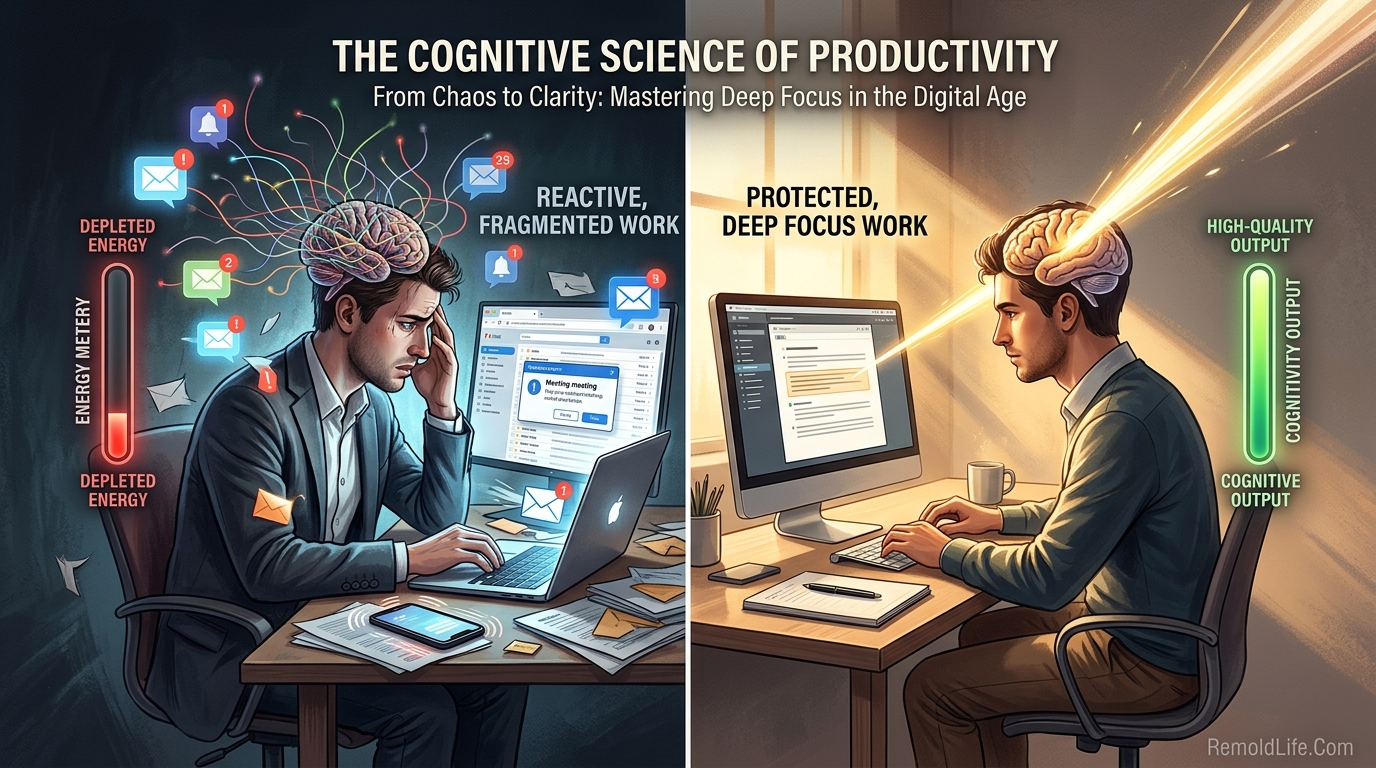

Learning how to be more productive at work is genuinely valuable — but the advice on this topic tends toward two unhelpful extremes. One glorifies relentless hustle and treats exhaustion as a badge of honor. The other offers surface-level tips (use a planner! make lists!) that don’t address why people struggle with productivity in the first place.
Real workplace productivity is about doing the right things effectively — not doing more things faster. It requires understanding how attention and energy actually work, not just adding more structure to an already overcrowded day. This guide covers what the evidence says about sustainable high performance.
Why Traditional Productivity Advice Often Fails
Most productivity systems treat people like machines — inputs produce outputs, more hours mean more work, and focus is a dial you simply turn up. This model doesn’t match how human cognition actually works.
Attention is a finite daily resource, not an unlimited one. Decision fatigue — the degradation of decision quality after a long series of choices — is a well-documented phenomenon. The brain’s capacity for deep focus is genuinely limited, and forcing sustained concentration beyond those limits produces diminishing returns and accelerating error rates.
Research by productivity scientist Anders Ericsson found that elite performers across fields — musicians, chess players, athletes — rarely sustain more than 4–5 hours of genuinely focused work per day. More hours worked didn’t produce more high-quality output; it produced more time spent at lower performance levels.
This reframes the productivity question from “how do I do more?” to “how do I do my most important work in the time I have?”
Principle 1: Protect Your Peak Energy Window for Deep Work
Not all hours of the day are equal for cognitive performance. Most people have a 2–4 hour window of peak mental performance — typically in the morning for morning chronotypes, but this varies individually.
Identify yours. This is when:
- Your thinking is clearest and most creative
- Decisions feel less difficult
- Sustained focus comes most easily
Then ruthlessly protect this window for your most important, cognitively demanding work. Don’t schedule meetings during it. Don’t check email. Don’t handle administrative tasks. Whatever your most difficult or highest-value work is — do it then.
Research by Cal Newport, whose book Deep Work is one of the most cited productivity texts of the decade, argues that the ability to perform concentrated focus on cognitively demanding tasks is both increasingly rare and increasingly valuable in knowledge work economies.
Principle 2: Use Time Blocking — Not Just To-Do Lists
To-do lists tell you what to do. They don’t tell you when, for how long, or in what order. The result is a list of tasks competing for your attention with no framework for making decisions about priority.
Time blocking assigns specific tasks to specific time slots in your calendar — turning intentions into scheduled commitments.
A practical time blocking framework:
| Block Type | Time | What Goes Here |
|---|---|---|
| Deep work block | Peak energy window (2–4 hrs) | Most important, cognitively demanding task |
| Admin block | Mid-morning or early afternoon | Email, messages, scheduling |
| Meeting block | Late morning or early afternoon | All meetings grouped together |
| Creative/planning block | Mid-afternoon | Planning, brainstorming, lower-intensity creative |
| End of day review | Final 15 minutes | Review what happened, set tomorrow’s priorities |
The key insight: once something is in the calendar, it stops competing for your attention. Your system has already made the decision.

Principle 3: Apply the 80/20 Rule to Your Task List
The Pareto Principle — that roughly 80% of outcomes come from 20% of inputs — applies clearly to workplace productivity. Most of the meaningful impact you produce comes from a small fraction of your activities. Most of your time is spent on activities that produce little meaningful output.
Before starting any workday, ask: “If I could only complete one task today, what would have the greatest impact?” Do that first. Then ask the same question about what’s left.
This sounds simple but requires resisting the compelling pull of easy tasks — emails to answer, requests to handle, minor items to check off — that feel productive without advancing anything significant.
Research by management professor Gary Keller (The ONE Thing) found that people who focused on single high-priority tasks before anything else consistently outperformed those who multitasked or worked reactively through their inbox.
Principle 4: Email and Messaging — Reclaim Your Attention
Email and messaging apps are productivity’s most effective enemy — not because they’re inherently bad, but because the constant-check habit they create is incompatible with the sustained focus that produces meaningful work.
Every notification is an interruption. Research by Gloria Mark at the University of California, Irvine found it takes an average of 23 minutes to fully regain focus after an interruption. If you check email or messages every 15 minutes, you’re never in a deep focus state.
What actually works:
- Designated email windows — 3 times daily (morning, midday, end of day) is sufficient for most roles. Some roles require more, but few require constant monitoring.
- Turn off desktop and phone notifications for email and messaging apps outside of your designated windows
- Clear your inbox using a simple system — respond immediately to emails taking under 2 minutes, archive those needing no action, schedule time for those needing more thought
- Communicate expectations — let colleagues know your response timeline. Most people adjust when expectations are clear.
Principle 5: Manage Meetings Ruthlessly
Meetings are one of the largest productivity drains in organizational life. Research by McKinsey found that executives spend an average of 23 hours per week in meetings — many of which are duplicative, unproductive, or entirely unnecessary.
Practical meeting management:
- Default to declining — is your attendance actually necessary? Could you receive a summary instead?
- 50-minute meetings instead of 60 — this prevents back-to-back meeting days that leave no time for actual work
- Require agendas — meetings without stated purposes and desired outcomes rarely produce either
- Standing meetings — literally standing reduces meeting duration by approximately 34% without reducing decision quality, according to research published in Social Psychological and Personality Science
- Batch meetings together — rather than one meeting at 9am, one at 11am, and one at 2pm that fragment your day into unusable segments, group them in consecutive blocks

Principle 6: Eliminate the Two Biggest Focus Killers
Your Phone During Work Hours
Unless your work explicitly requires it, your phone during focused work time is pure distraction. Research by Adrian Ward at the University of Texas found that simply having your phone on your desk — face down, silent — reduces cognitive capacity compared to having it in another room. The mere presence of the phone diverts attention, even when it’s not being used.
Put it in a drawer or different room during focus blocks. The world rarely ends in the 90 minutes you’re not available.
Multitasking
Multitasking on cognitively demanding tasks doesn’t exist — what it actually is, is rapid task switching, and each switch carries a cognitive cost. Research at Stanford found that heavy multitaskers performed worse on tasks requiring focus, memory filtering, and task-switching than light multitaskers — suggesting the habit actually degrades the relevant capacities over time.
Doing one thing at a time is not a retro productivity hack. It’s what actually produces quality work.
Principle 7: Manage Your Energy, Not Just Your Time
Time management without energy management is incomplete. You can schedule the perfect day and still produce poor work if you’re depleted, hungry, or mentally saturated.
Key energy management practices:
Take actual breaks. Working through breaks doesn’t produce more output — it produces more output of declining quality. Research on restoration theory (by Stephen Kaplan, University of Michigan) shows that genuine rest during the day — walking outside, non-screen quiet time — restores directed attention more effectively than grinding through.
Protect lunch. A 20–30 minute break from screens and work allows cognitive recovery that measurably improves afternoon performance.
Recognize depletion signals early. Making poor decisions, becoming irritable, losing focus, or producing increasingly low-quality work are all signals that you need recovery — not more coffee.
Schedule your hardest work when you’re freshest. The sequence of tasks through the day matters. Administrative work in the morning burns the cognitive fuel you need for complex problems.
Principle 8: The End-of-Day Shutdown Ritual
One underrated productivity practice is a consistent end-of-day shutdown ritual — a specific process that signals the workday is complete and closes the mental tabs that otherwise stay open.
Research by Bluma Zeigarnik found that the mind continues to process unfinished tasks — creating the intrusive thoughts about work that invade evenings and weekends. A brief end-of-day review and planning session closes those loops:
- Review what you completed today
- Capture any open tasks that need to be scheduled
- Set your top 2–3 priorities for tomorrow
- Physically close work applications
After completing this ritual, say a specific phrase or take a specific action that signals “work is done.” This shutdown cue, practiced consistently, reduces the frequency of intrusive work thoughts during off-hours and improves sleep quality.
Common Productivity Mistakes to Avoid
| Mistake | Why It Doesn’t Work | Better Approach |
|---|---|---|
| Starting with email | Puts you in reactive mode for the day | Do most important task first |
| Meetings all morning | Destroys deep work window | Block mornings for focus, group meetings afternoon |
| Working longer hours | Produces diminishing returns after 6–7 hours | Work smarter within a protected schedule |
| No written priorities | Everything feels equally urgent | Write 3 priorities the night before |
| Open notification settings | Constant interruption, never in flow | Designate check-in times, disable otherwise |
| Perfection on everything | Prevents completion | Reserve high standards for high-impact work |

Frequently Asked Questions
Research by Ericsson and others studying deliberate practice suggests 4–5 hours of genuinely focused, high-quality cognitive work is near the upper limit for most people. Beyond that, quality degrades. The goal isn’t maximizing hours but maximizing output within your genuine capacity — and protecting recovery so the next day’s capacity is maintained.
It depends on the person and the setup. Remote work eliminates commuting and reduces certain interruptions — real benefits. It also blurs work/rest boundaries, increases some types of distraction (household tasks, family), and reduces spontaneous collaboration. The research is genuinely mixed. The most productive remote workers are those who deliberately structure their environment and schedule rather than working in an unstructured way at a kitchen table.
Identify whether the interruptions are genuinely urgent or simply habitual. For roles with legitimate interrupt demands, batch non-interrupt work into early morning before others arrive, negotiate focused work windows with your team, or use signals (headphones, status indicators) to communicate focus time. Some roles don’t permit deep work — if high-quality focused output is critical to your role, that’s worth a conversation with your manager about structure.
Yes — for many people. Working in 25-minute focused blocks followed by 5-minute breaks provides enough structure to overcome starting resistance, prevents burnout through built-in recovery, and creates a measurable rhythm. The specific timing (25/5) matters less than the principle — work in defined focused intervals with genuine breaks. Some people prefer longer blocks (50/10 or 90/20) and those work just as well.
Waiting for motivation before starting is the procrastination trap. Motivation typically follows action rather than preceding it — starting a task, even briefly and with low enthusiasm, usually generates enough momentum to continue. The 2-minute rule (commit only to starting for 2 minutes) is effective because it removes the activation barrier. Also: distinguish between low-motivation days (normal) and sustained burnout (requires rest, not productivity hacks).
Final Thoughts
Real productivity at work isn’t about squeezing more tasks into every hour. It’s about protecting the conditions under which your best thinking happens — protecting focused time, managing energy deliberately, and being ruthless about where your attention goes.
The practices above aren’t complicated. They require consistency and the willingness to push back on the always-on culture that mistakes busyness for output. Most people who implement even three or four of these consistently find their work quality improves and their stress reduces simultaneously.
For related reading on building the underlying habits that support productive work, how to stop procrastinating addresses the psychological root of avoidance, and how to develop good habits that last covers the behavioral science of making these practices stick.
Sources:
- Ericsson KA — Deliberate Practice and Expert Performance Research, Florida State University
- Newport C — Deep Work (2016) — Rules for Focused Success in a Distracted World
- Mark G — Attention and Interruption Research, UC Irvine
- Ward AF et al. — “Brain Drain: The Mere Presence of One’s Own Smartphone.” Journal of the Association for Consumer Research (2017)
- Keller G — The ONE Thing (2013)
- Bluedorn AC et al. — Standing Meetings and Decision Quality. Social Psychological and Personality Science (1999)
- UC Irvine — Gloria Mark Attention and Interruption Research: https://www.ics.uci.edu/
- American Psychological Association — Decision Fatigue and Workplace Productivity: https://www.apa.org/
- McKinsey Global Institute — Meeting Productivity Research: https://www.mckinsey.com/mgi