 Skip to content

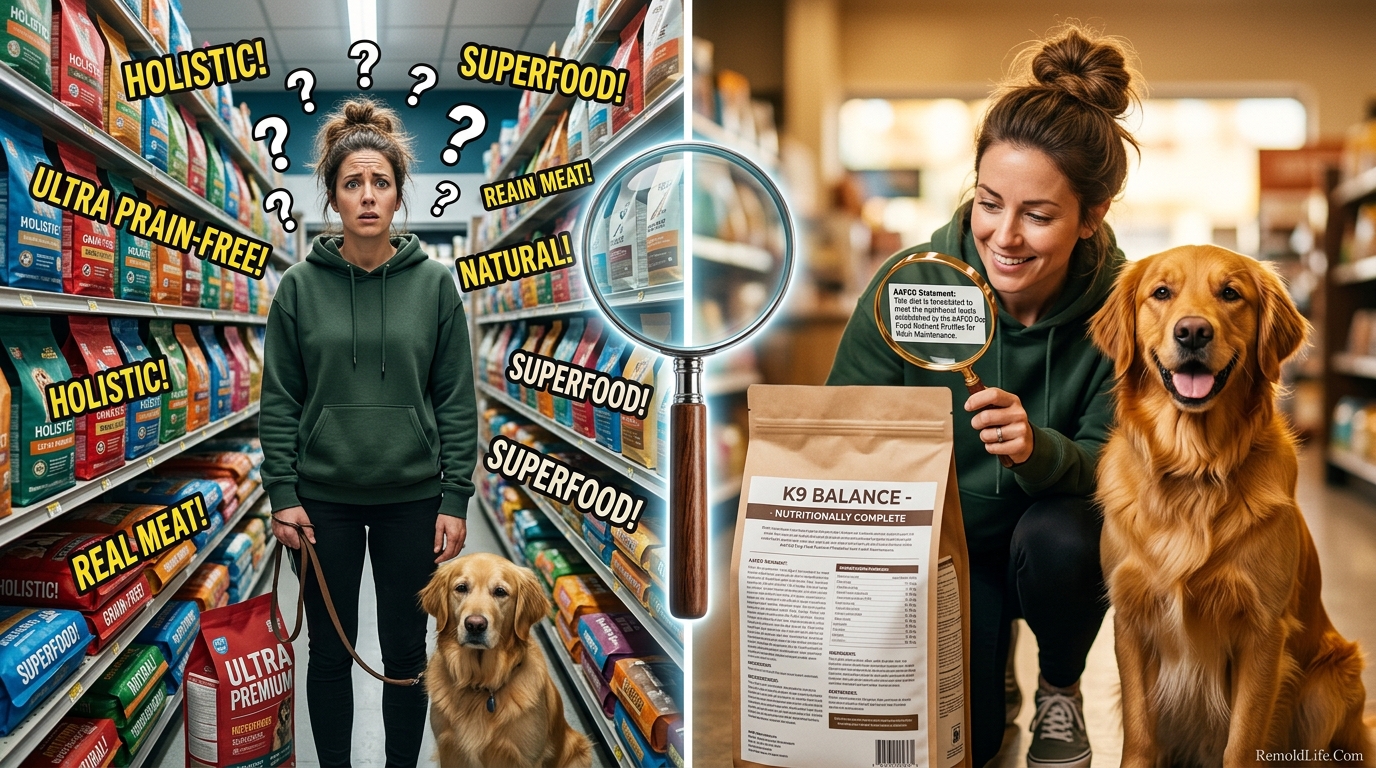

Knowing how to choose dog food is more confusing than it should be — because the pet food industry combines genuine nutritional science with aggressive marketing that often has little to do with what’s actually good for your dog. Words like “premium,” “holistic,” “natural,” and “grain-free” appear on packaging without consistent regulatory meaning.
This guide cuts through the marketing and focuses on what veterinary nutrition guidelines and independent research actually support. The goal is finding a food that genuinely meets your dog’s nutritional needs — without overpaying for branding or being misled by ingredient trends.
Start Here: The AAFCO Statement
Before reading any other part of a dog food label, find the AAFCO nutritional adequacy statement. This is the single most important piece of information on the package.
The Association of American Feed Control Officials (AAFCO) sets the nutritional standards that commercial pet foods must meet. A food that carries an AAFCO statement has either:
- Met AAFCO nutrient profiles — formulated to contain the nutrients AAFCO requires for the stated life stage, OR
- Passed AAFCO feeding trials — actually fed to dogs over a period to confirm it supports health
The statement will specify the life stage: “puppy,” “adult,” “senior,” or “all life stages.”
What to look for:
- “Complete and balanced for [life stage]” — this means it’s intended as your dog’s primary diet
- “Intended for intermittent or supplemental feeding only” — this is NOT a complete diet and should not be the primary food
If a food doesn’t have an AAFCO statement at all, it’s not a complete diet regardless of how premium the packaging looks.
Understanding Life Stage Nutrition
Dogs have meaningfully different nutritional needs depending on their age and reproductive status.
Puppies
Puppies need more protein, fat, calcium, and phosphorus than adult dogs to support rapid growth. Puppy foods are specifically formulated with these higher levels. Large breed puppies (expected adult weight over 25kg) need a large breed puppy formula specifically — standard puppy foods have calcium and phosphorus levels that are too high for large breed development and can contribute to skeletal problems.
Adult Dogs (1–7 years)
Adult maintenance formulas are appropriate once dogs reach their full size — roughly 12 months for small breeds, 18–24 months for large and giant breeds. Adult foods are lower in protein and fat than puppy foods.
Senior Dogs (7+ years)
Senior dogs have different needs — typically lower calorie density, more easily digestible protein, and sometimes joint support ingredients. However, “senior” isn’t tightly regulated in pet food — look specifically for AAFCO statements addressing senior dogs’ actual nutritional needs rather than just the “senior” label.
Pregnant and Nursing Dogs
Pregnant and nursing females require significantly more calories, protein, and calcium. Foods formulated for “all life stages” that have passed AAFCO feeding trials are appropriate — puppy food is also often recommended because its higher nutrient density supports the demands of pregnancy and lactation.

Reading the Ingredient List Correctly
Ingredients are listed by weight before processing — which matters more than it first appears.
Named protein sources first: The first ingredient should be a named animal protein: “chicken,” “beef,” “salmon,” “turkey” — not vague terms like “meat” or “poultry.” A named source allows accountability and quality assessment.
“Meal” is not necessarily bad: “Chicken meal” is chicken with water removed — it’s actually a more concentrated protein source than fresh chicken listed first. “Chicken meal” as the first ingredient can mean more actual protein than “chicken” listed first (because fresh chicken is about 70% water, which evaporates in processing).
Ingredient splitting: Watch for the same ingredient appearing multiple times under different names — “corn,” “corn meal,” “corn gluten meal.” Each individual ingredient looks small, but combined they may represent a large portion of the food. This is a marketing tactic to make protein look like it appears higher on the list than fillers.
Grains aren’t automatically bad: Despite the marketing around grain-free diets, corn, wheat, oats, and rice are digestible carbohydrate sources that provide energy. The FDA issued an ongoing investigation in 2018 linking grain-free, legume-heavy diets to dilated cardiomyopathy (DCM — a serious heart condition) in dogs. As of 2026, this investigation remains ongoing and grain-free diets are generally not recommended without a specific medical reason.
Dry Kibble vs. Wet Food vs. Fresh/Raw: The Honest Comparison
| Format | Pros | Cons | Best For |
|---|---|---|---|
| Dry kibble | Affordable, convenient, shelf-stable, dental benefit | Lower moisture (not ideal for dogs needing hydration) | Most dogs; primary diet |
| Wet/canned | High moisture, palatable, good for picky eaters | More expensive, opens must be refrigerated | Senior dogs, picky eaters, dogs needing hydration |
| Fresh (cooked) | Human-grade ingredients, high palatability | Expensive, requires refrigeration, verify AAFCO compliance | Dogs with specific needs or owner preference if budget allows |
| Raw | Advocates cite digestibility benefits | No strong evidence of superiority over cooked; food safety risks (Salmonella); harder to balance; FDA/AVMA caution | Not recommended by most veterinary nutritionists |
The American Veterinary Medical Association (AVMA) opposes raw protein diets for dogs, citing food safety risks to both pets and human household members and the absence of evidence for claimed benefits over commercially prepared cooked food.
For most healthy dogs, a high-quality dry kibble meeting AAFCO standards is nutritionally complete, practical, and affordable. Adding some wet food or fresh toppers for variety and palatability is fine.
Understanding Protein Needs
Dogs are omnivores but thrive on high-protein diets. Protein requirements vary by life stage:
| Life Stage | Minimum Protein (AAFCO) | Recommended Range |
|---|---|---|
| Adult | 18% dry matter basis | 22–30% |
| Puppy | 22% dry matter basis | 25–35% |
| Active/working dogs | Higher needs | 30%+ |
| Senior (healthy) | Similar to adult | 25–30% |
| Dogs with kidney disease | Restricted protein | Per vet recommendation |
Dry matter basis is the correct comparison method. Because wet foods contain more water than dry, comparing percentages on the label is misleading. To compare accurately, use the dry matter basis calculation: divide protein % by (100% minus moisture %) × 100.
For example: a wet food showing 10% protein with 78% moisture = 10/(100-78)×100 = 45.5% protein on a dry matter basis — much higher than it appears on the label.
Brands Worth Considering (and Why)
Rather than listing “best brands” — which becomes outdated quickly — here are the characteristics that distinguish reliably researched brands:
- Employs a board-certified veterinary nutritionist to formulate recipes
- Conducts AAFCO feeding trials rather than just nutrient profile analysis
- Has research published in peer-reviewed journals
- Has a history of minimal recall issues
- Is transparent about ingredient sourcing when asked
Brands consistently recommended by veterinary nutritionists across multiple surveys include Hill’s Science Diet, Royal Canin, and Purina Pro Plan — none of which are glamorously marketed, but all of which have extensive research, nutritionist oversight, and quality control. This doesn’t mean other brands are necessarily inferior, but these specifically have the strongest evidence base among veterinary professionals.

Special Dietary Considerations
Allergies and Food Sensitivities
True food allergies in dogs are less common than often believed — skin issues are frequently environmental rather than food-triggered. When food allergy is genuinely suspected, a hydrolyzed protein diet or novel protein diet (a protein the dog has never eaten before) under veterinary guidance is the appropriate approach — not simply switching to a “grain-free” food.
Weight Management
Overweight dogs need a diet with reduced calorie density, not simply smaller portions of regular food (which reduces nutrients alongside calories). Weight management formulas maintain nutrient levels while reducing calories. The AVMA notes that obesity is one of the most significant preventable health problems in dogs.
Joint Health
Large and giant breed dogs benefit from foods containing glucosamine and chondroitin — which support cartilage health — particularly from middle age onward. Many large breed formulas include these.
Dogs with Medical Conditions
Kidney disease, diabetes, liver disease, urinary crystals, cardiac conditions — all require specific dietary management. In these cases, prescription veterinary diets formulated for the specific condition are the appropriate choice, recommended under veterinary guidance rather than over-the-counter alternatives.
How Much to Feed
The feeding guide on your dog food bag is a starting point — not a precise prescription. Individual dogs vary in metabolism, activity level, and body condition.
The right amount to feed is the amount that maintains an ideal body condition score. Check your dog’s condition every 2–4 weeks:
- Ribs should be easily felt but not prominently visible
- A visible waist from above
- A slight abdominal tuck from the side
If your dog is gaining weight, reduce by 10% and reassess. If losing weight unintentionally, increase and have a vet evaluate.
Most adult dogs do well with two measured meals per day rather than free-feeding — which makes portion control easier and establishes predictable hunger patterns.
Frequently Asked Questions
Not generally — and often the opposite. Homemade diets are notoriously difficult to balance. A study published in the Journal of Nutritional Science found that the vast majority of homemade dog diet recipes available online were nutritionally inadequate — deficient in one or more essential nutrients. If you want to feed homemade, work with a board-certified veterinary nutritionist to develop a properly balanced recipe.
Gradually over 7–10 days. Days 1–3: 75% old food, 25% new. Days 4–6: 50/50. Days 7–9: 25% old, 75% new. Day 10+: 100% new food. This prevents digestive upset, which is common with sudden food changes.
“Human-grade” means ingredients were processed in facilities meeting human food standards — it doesn’t automatically mean the recipe is nutritionally superior. Some human-grade brands are excellent; others are nutritionally inadequate. Apply the same AAFCO evaluation regardless of how the food is marketed.
There’s no requirement to rotate, and frequent changes can cause digestive upset. Dogs don’t need dietary variety the way humans do. If you want to provide variety, rotating between flavors within the same brand (which maintains consistent formulation quality) is less disruptive than switching brands entirely.
The FDA maintains a searchable database of pet food recalls at FDA.gov/animal-veterinary. Signing up for alerts from the FDA and from sites like DogFoodAdvisor.com provides proactive notification. Checking recalls before purchasing a new brand is worthwhile.

Final Thoughts
Choosing the right dog food doesn’t require becoming a pet nutrition expert. It requires knowing the right criteria: an AAFCO complete and balanced statement, a named protein source as the primary ingredient, appropriate life stage formulation, and a brand with genuine nutritional oversight.
The most elaborately packaged, expensively marketed food isn’t necessarily better than a more modest brand that meets these criteria. Let the AAFCO statement and your vet’s guidance — not the packaging — drive the decision.
For related pet health content, how to keep a dog healthy covers the full daily care picture beyond nutrition, and common cat health problems is useful for households with both species.
Sources:
- Association of American Feed Control Officials — Pet Food Standards: https://www.aafco.org/
- American Veterinary Medical Association — Raw Protein Diet Position Statement: https://www.avma.org/
- FDA — Investigation Into DCM and Grain-Free Diets: https://www.fda.gov/animal-veterinary
- Larsen JA, Fascetti AJ — “Nutritional Adequacy of Homemade Dog Diets.” Journal of Nutritional Science (2014)
- Veterinary Information Network — Veterinary Nutritionist Recommendations (2025)