 Skip to content

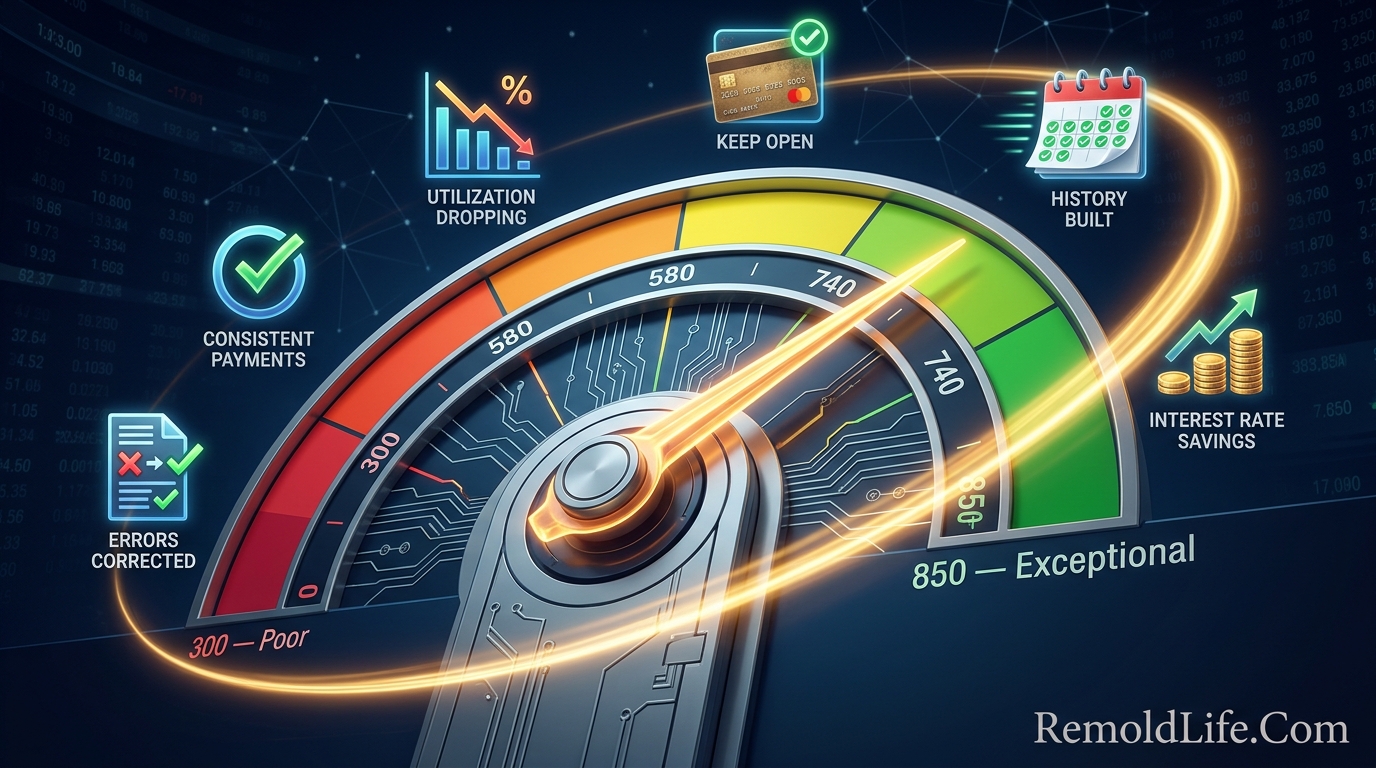

Learning how to improve your credit score fast is worth prioritizing because your credit score affects far more than just loan approvals. It influences the interest rate you pay on a mortgage, whether a landlord approves your application, what you pay for car insurance in many states, and sometimes even whether you get a job offer.
The good news is that credit scores respond to specific actions — and some of those actions produce measurable improvements within 30 to 60 days. This guide covers exactly what moves the score, which changes produce the fastest results, and how to build a consistently strong credit profile over time.
How Credit Scores Are Calculated
Understanding the formula is essential because improvement efforts need to be targeted at the factors with the most weight.
The FICO score — used by approximately 90% of top lenders — is calculated from five factors:
| Factor | Weight | What It Measures |
|---|---|---|
| Payment history | 35% | Whether you pay on time — the single biggest factor |
| Credit utilization | 30% | How much of your available credit you’re using |
| Length of credit history | 15% | How long your accounts have been open |
| Credit mix | 10% | Variety of account types (cards, loans, mortgage) |
| New credit | 10% | Recent applications and new accounts |
Source: myFICO / Fair Isaac Corporation
The most important insight: payment history and credit utilization together account for 65% of your score. Improving these two factors produces the fastest and most significant results.
Step 1: Check Your Credit Reports for Errors
Before doing anything else, get your free credit reports and review them for errors. Errors are more common than most people realize — a 2021 study by the Consumer Financial Protection Bureau found that a significant percentage of credit reports contain inaccuracies that affect scores.
You’re entitled to free weekly reports from all three bureaus — Equifax, Experian, and TransUnion — at AnnualCreditReport.com.
What to look for:
- Accounts you don’t recognize (potential fraud or identity theft)
- Late payments listed incorrectly
- Balances shown as higher than they are
- Closed accounts listed as open
- Duplicate accounts
- Accounts that should have fallen off (negative items generally stay for 7 years; bankruptcy up to 10)
Disputing errors: If you find an error, dispute it directly with the bureau reporting it. Each bureau has an online dispute process. The bureau must investigate and respond within 30 days. Legitimate errors — when corrected — can produce immediate score improvement.

Step 2: Reduce Credit Utilization — The Fastest Score Boost
Credit utilization is the ratio of your current credit card balances to your total credit limits. If your limit across all cards is $10,000 and your balances total $3,000, your utilization is 30%.
This factor updates monthly — when your statement closes and the balance is reported to the bureaus. That means lowering your utilization produces score improvement within one to two billing cycles — faster than almost any other action.
Utilization benchmarks:
| Utilization Rate | Impact on Score |
|---|---|
| Under 10% | Excellent — strongest positive impact |
| 10–30% | Good — acceptable range |
| 30–50% | Moderate — some negative impact |
| 50–75% | Significant negative impact |
| 75–100% | Serious negative impact |
| Over 100% | Severe negative impact |
How to reduce utilization quickly:
Pay down balances before the statement closes — your credit card reports your balance on the statement closing date, not the due date. Paying down your balance before closing produces lower reported utilization even if you pay the full balance by the due date.
Ask for a credit limit increase — if you have a history of on-time payments, many card issuers will increase your limit with a soft inquiry (which doesn’t affect your score). Higher limit + same balance = lower utilization percentage.
Spread balances across cards — if one card is near its limit while others have low utilization, moving some balance to a card with more available credit can improve your overall utilization profile.
Pay more than once a month — making multiple payments during a billing cycle keeps the reported balance lower.
Step 3: Never Miss a Payment — And Catch Up If You Have
Payment history is the single largest factor in your score at 35%. A single missed payment can drop your score significantly — the impact depends on your starting score, but a 30-day late payment can reduce a score in the 700s by 60–110 points according to FICO data.
The damage from missed payments also lingers — late payments stay on your report for seven years, though their impact diminishes over time.
Immediate actions:
- Set up autopay for at least the minimum payment on every account — this guarantees on-time payment regardless of whether you remember
- If you’ve missed a payment recently, pay it as soon as possible — a payment becomes more damaging the older it gets (30 days late vs 60 days late vs 90+ days late)
- Contact your creditor if you’re struggling — many have hardship programs that can temporarily prevent late payment reporting
What if you have old late payments? You can’t remove accurate negative information — but it does become less impactful over time. If a late payment was a one-time error on an otherwise clean account, you can write a goodwill letter to the creditor asking them to remove it. This sometimes works, particularly for long-standing customers.

Step 4: Don’t Close Old Accounts
This surprises many people. Closing a credit card account doesn’t remove it from your credit report immediately — but it does reduce your total available credit, which increases your overall utilization ratio. Closing an old card also potentially shortens your average account age over time.
The general rule: keep your oldest cards open and active, even if you don’t use them regularly. A small recurring charge (like a streaming subscription) paid automatically keeps the account active without risk of accumulating debt.
The one exception: if a card has a high annual fee that doesn’t justify the benefit, closing it may make financial sense — but understand it may have a short-term score impact.
Step 5: Be Strategic About New Credit Applications
Each time you apply for new credit, a hard inquiry is placed on your report. Hard inquiries lower your score slightly — typically 5–10 points — and stay on your report for two years (though they only affect your score for one year).
If you’re actively working to improve your score, avoid applying for new credit cards or loans unless necessary. Multiple applications in a short period signals financial stress to lenders.
Exception: When shopping for a mortgage or auto loan, multiple inquiries within a 14–45 day window (depending on the FICO version) are counted as a single inquiry — because lenders recognize you’re rate shopping for one loan, not applying for multiple new credit lines.
Step 6: Diversify Your Credit Mix Over Time
Credit mix — having a variety of account types (credit cards, auto loan, mortgage, student loans) — accounts for 10% of your score. You don’t need every type, and you shouldn’t take on debt just for credit mix purposes. But if you only have credit cards and no installment loans, adding one type over time (when you genuinely need it) can modestly benefit your score.
A credit-builder loan — offered by many credit unions specifically for this purpose — is a low-risk way to add an installment account if you have thin credit history. You make monthly payments that are reported to the bureaus, and receive the loan amount at the end of the term.
How Long Improvement Takes
Here’s a realistic timeline for different starting situations:
| Situation | Expected Timeline for Improvement |
|---|---|
| Error on report — disputed and corrected | 30–45 days after correction |
| High utilization — paid down significantly | 1–2 billing cycles (30–60 days) |
| No late payments in past year | 6–12 months of on-time payments shows meaningful trend |
| Recovering from 30-day late payment | 12–18 months of clean history significantly reduces impact |
| Recovering from serious delinquency / collections | 2–4 years of consistent positive behavior |
| Building from no credit history | 6–12 months to establish a score; 18–24 months for a solid one |
The fastest improvements come from utilization reduction and error correction. Rebuilding from negative payment history takes longer — there’s no shortcut, but consistent positive behavior genuinely does rehabilitate a damaged score over time.
Credit Score Ranges and What They Mean
| FICO Score Range | Category | Practical Implication |
|---|---|---|
| 800–850 | Exceptional | Best available rates on all products |
| 740–799 | Very Good | Near-best rates; excellent approval odds |
| 670–739 | Good | Standard rates; approved for most products |
| 580–669 | Fair | Higher rates; some products unavailable |
| Below 580 | Poor | Limited options; secured cards or credit-builder loans |
Moving from Fair to Good (580 to 670+) is where the most dramatic practical benefits occur — this range unlocks unsecured credit cards and substantially lower loan rates.
Frequently Asked Questions
Checking your own credit score or report is a soft inquiry and has zero effect on your score. Only hard inquiries — when a lender checks your credit in response to an application — affect your score. Check your own credit freely without concern.
Legitimate credit repair involves disputing actual errors — which you can do yourself for free. Companies that charge fees to “repair” your credit are doing the same thing you can do at no cost. Be extremely skeptical of any company claiming to remove accurate negative information — this isn’t possible through any legal method, regardless of what they charge. The CFPB’s guidance on credit repair explains what these companies can and cannot do.
No. Your income is not part of your credit score calculation at all. Your credit score reflects your behavior with credit — payment history, utilization, account age — not your income level. However, income is considered separately by lenders when evaluating loan applications.
A score in the 700–739 range is considered “Good” by FICO standards — you’ll qualify for most credit products at reasonable rates, though not the absolute best rates available to those above 740. Moving from 700 to 760+ typically saves meaningful money on mortgages and auto loans through better interest rates.
Start with a secured credit card (you provide a deposit that becomes your credit limit), a credit-builder loan from a credit union, or becoming an authorized user on a family member’s account. Use the secured card for small regular purchases and pay the full balance monthly. After 6–12 months of on-time payments, you’ll have a starter score, and many secured cards automatically upgrade to unsecured after 12–18 months of good behavior.

Final Thoughts
Improving your credit score isn’t mysterious — it’s responsive to specific, predictable actions. Pay on time, reduce utilization, correct errors, keep old accounts open, and be patient.
The fastest wins are utilization reduction (can show results in 30–60 days) and error correction (results after the dispute is resolved). The longer game — rebuilding payment history — takes months to years but consistently improves with time and clean behavior.
Your credit score is a financial tool that affects the cost of borrowing for decades. Investing time in understanding and improving it returns tangible financial benefits every time you apply for a mortgage, car loan, or even a new apartment.
For related financial reading, how to get out of credit card debt covers the debt payoff strategies that directly improve credit utilization, and how to create a monthly budget helps you manage money in a way that prevents missed payments in the first place.
Sources:
- myFICO / Fair Isaac Corporation — Credit Score Factors: https://www.myfico.com/credit-education/whats-in-your-credit-score
- Consumer Financial Protection Bureau — Credit Reports and Scores: https://www.consumerfinance.gov/
- AnnualCreditReport.com — Free Credit Reports: https://www.annualcreditreport.com/
- Consumer Financial Protection Bureau — Credit Repair: https://www.consumerfinance.gov/ask-cfpb/what-is-a-credit-repair-company-en-1517/
- Experian — Credit Score Range Guide: https://www.experian.com/