 Skip to content

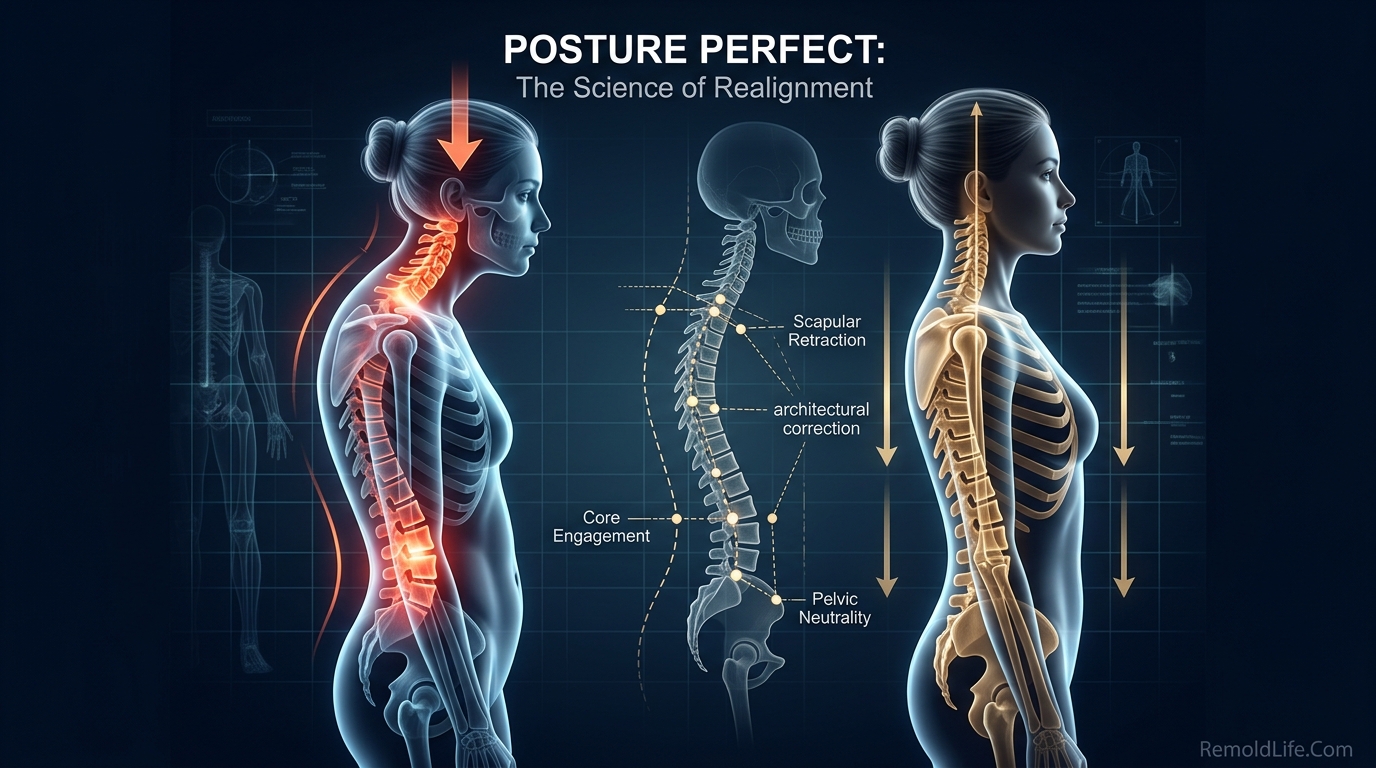

The signs of poor posture are often more widespread than people expect. Most people associate bad posture with back pain — and while that connection is real, poor alignment affects far more than your spine. Headaches, jaw tension, reduced lung capacity, digestive discomfort, fatigue, and even mood are all influenced by how you habitually hold your body.
This guide covers how to recognize the signs, what causes poor posture to develop, and — most importantly — the specific corrections that actually work, with a realistic at-home routine you can start today.
What “Good Posture” Actually Means
Good posture is not standing rigidly upright with your chest pushed out and chin tucked. That description comes from old military posture culture and actually creates its own tension patterns.
Good posture means that your body is aligned in a way that:
- Minimizes unnecessary muscle effort to maintain your position
- Distributes load evenly across joints and muscles
- Allows your lungs to fully expand
- Keeps your spine in its natural curves (not flattened or exaggerated)
The three natural spinal curves — cervical (neck), thoracic (mid-back), lumbar (lower back) — are meant to be present and gently maintained, not eliminated. The goal is balance and ease, not rigidity.
Common Signs of Poor Posture
1. Forward Head Position
This is one of the most common posture problems in 2026, driven significantly by smartphone and computer use. Your head sits forward of its ideal position over your shoulders — sometimes called “tech neck.”
How to check: Stand naturally and have someone take a side-profile photo. In ideal alignment, your ear should be roughly above your shoulder, which should be above your hip. If your ear is noticeably ahead of your shoulder, forward head position is present.
The mechanical problem: For every inch your head moves forward of neutral, the effective weight on your neck roughly doubles. A head that weighs 10–12 pounds can exert 40–60 pounds of force on the cervical spine when held 3–4 inches forward.
Symptoms: Neck stiffness, headaches (particularly at the base of the skull and behind the eyes), shoulder tension, and upper back tightness.
2. Rounded Shoulders
Rounded shoulders occur when the shoulder blades wing outward and the chest tightens — creating a hunched appearance when viewed from the side or front.
How to check: Stand naturally with your arms at your sides. Look down at your hands — if your knuckles face forward rather than to the sides, your shoulders are internally rotated and likely rounded forward.
What causes it: Sustained forward-reaching postures (typing, driving, looking at phones), weak upper back muscles, and tight chest muscles create this pattern over time.
Symptoms: Upper back aching, shoulder impingement (pain when lifting arm), limited shoulder range of motion.

3. Anterior Pelvic Tilt
Anterior pelvic tilt occurs when the front of the pelvis drops and the back rises — creating an exaggerated lower back curve (lumbar lordosis). Visually, the lower back arches noticeably and the belly protrudes even in people without excess weight.
How to check: Stand with your back against a wall. In neutral pelvis, you should be able to fit one hand (but not two) between the wall and your lower back. If there’s significantly more space, anterior pelvic tilt may be present.
What causes it: Prolonged sitting tightens hip flexors (the muscles that pull the pelvis forward) and weakens glutes and core muscles that should counterbalance them.
Symptoms: Lower back pain — the most common complaint associated with this pattern — hip flexor tightness, and sometimes knee pain from altered biomechanics.
4. Kyphosis (Rounded Upper Back / “Hunchback”)
Kyphosis refers to excessive outward curvature of the thoracic spine — beyond the normal gentle curve. Mild kyphosis develops gradually through posture habits; more severe forms can have structural causes.
How to check: Stand against a wall and see if your upper back naturally contacts it. Significant rounding will create obvious space between the wall and your mid-back.
What causes it: Sustained hunching over desks, phones, or steering wheels; weak upper back extensors; tight chest and anterior shoulder muscles.
Symptoms: Mid-back stiffness and aching, reduced breathing capacity (rounded thorax compresses lungs), fatigue from sustained muscle effort to maintain upright position.
5. Uneven Shoulders or Hips
Standing in front of a mirror, if one shoulder or hip appears noticeably higher than the other, this can indicate muscular imbalance, habitual weight-shifting, or in some cases scoliosis (lateral spinal curvature).
Minor asymmetry is normal and universal. Significant, persistent asymmetry — particularly if accompanied by pain on one side — is worth having assessed by a physiotherapist or physician.
Why Poor Posture Develops
Posture problems are largely a product of modern life patterns:
Prolonged sitting — the human body wasn’t designed for hours of sustained sitting. Seated posture places continuous load on spinal discs, shortens hip flexors, and allows core and glute muscles to become underactive.
Screen time — the posture most people adopt when looking at phones and computers draws the head forward, internally rotates the shoulders, and rounds the upper back.
Muscle imbalances — when some muscles are chronically tight (hip flexors, chest, anterior shoulder) and others are chronically underworked (glutes, deep neck flexors, thoracic extensors), the body settles into misaligned defaults.
Stress — chronic stress creates characteristic tension patterns — raised and forward shoulders, shallow breathing, tightened jaw — that over time become structural habits.
How to Correct Poor Posture: A Practical Home Routine
Posture correction requires both releasing tight muscles and strengthening underused ones. Stretching alone doesn’t produce lasting change — neither does strength training alone. The combination is what shifts habitual alignment.
This routine takes approximately 10–15 minutes daily and addresses the most common patterns.
Part 1: Release Tight Muscles (5 minutes)
Chest and anterior shoulder stretch (for rounded shoulders): Stand in a doorway, place both forearms on the frame, and gently lean forward until you feel a stretch across your chest and front of shoulders. Hold 30 seconds, repeat twice.
Hip flexor stretch (for anterior pelvic tilt): Low lunge position — one knee on the floor, the other foot forward. Keep your torso upright and gently press your hip forward until you feel the stretch in the front of the hip of the back leg. Hold 30–45 seconds per side.
Levator scapulae stretch (for neck tension/forward head): Sit or stand. Tuck your chin slightly, then tilt your head toward one shoulder and look down toward your armpit at roughly a 45-degree angle. Place your hand gently on the back of your head for light overpressure. Hold 30 seconds per side.

Part 2: Activate Weak Muscles (7–10 minutes)
Chin tucks (for forward head position): Sitting or standing, gently retract your head straight back — like you’re trying to make a double chin. You should feel the back of your neck lengthen. Hold 5 seconds, repeat 10–15 times. This activates the deep cervical flexors that oppose forward head position.
Band pull-aparts or Y/T/W raises (for rounded shoulders and upper back): With a resistance band held in both hands at shoulder height and arms extended, pull the band apart by bringing your arms wide — squeezing your shoulder blades together. Perform 15–20 repetitions. Without a band, lie face down and raise arms in Y, T, and W shapes, squeezing the upper back at the top.
Glute bridges (for anterior pelvic tilt): Lie on your back, knees bent, feet flat on the floor. Press through your heels and raise your hips until your body forms a straight line from shoulders to knees. Squeeze your glutes at the top. Hold 2–3 seconds, lower, and repeat 15 times for 2–3 sets. This directly activates the glutes that counteract anterior pelvic tilt.
Dead bugs (for core activation): Lie on your back with arms extended toward the ceiling and knees bent at 90 degrees. Slowly lower one arm overhead while extending the opposite leg, maintaining your lower back contact with the floor. Return and repeat on the other side. 8–10 repetitions per side.
Ergonomic Adjustments for Sustained Improvement
Exercise addresses the muscular imbalances, but if you return to the same posture-compromising setup for 8+ hours a day, progress is slow. These adjustments matter:
| Setup | Recommendation |
|---|---|
| Monitor height | Top of screen at or slightly below eye level |
| Chair height | Hips at or slightly above knee level, feet flat on floor |
| Keyboard and mouse | Elbows at roughly 90 degrees, wrists neutral |
| Phone use | Bring the phone up to eye level rather than looking down |
| Standing desk | Use intermittently — alternating sitting and standing is better than sustained standing |
| Lumbar support | A small lumbar roll in the chair’s lower back curve supports neutral lumbar position |
The movement rule: Regardless of ergonomic setup, no sustained position — sitting or standing — is ideal for hours. Taking a 2-minute movement break every 45–60 minutes (standing, walking briefly, stretching) resets cumulative postural load better than any single ergonomic adjustment.
How Long Does Posture Correction Take?
With consistent daily effort on the routine above plus ergonomic adjustments:
- 2–4 weeks: Reduced muscle tightness and improved awareness of posture cues
- 6–8 weeks: Noticeable change in resting posture and reduced pain or tension
- 3–6 months: More lasting structural changes as muscles rebalance and new movement patterns become habitual
These timelines assume genuine consistency. Occasional stretching without the strengthening component produces slower results — and without ergonomic adjustments, improvements compete against the daily postural loading.
When to See a Professional
Self-guided posture correction works well for common patterns caused by muscle imbalance and habitual positioning. See a physiotherapist, chiropractor, or orthopedic specialist if:
- Pain is severe, persistent (more than 6 weeks), or radiates into your arms or legs
- You have numbness, tingling, or weakness in your limbs
- You have significant visible spinal curvature that hasn’t been assessed
- Self-correction isn’t producing improvement after 8–12 weeks of consistent effort
- You’ve had a recent injury or surgery
Frequently Asked Questions
Posture can genuinely improve permanently — when the underlying muscle imbalances are corrected and new movement patterns become habitual. The key is that correction requires both releasing tight muscles and strengthening their opposing counterparts, not just conscious effort to “sit up straight.” Conscious correction without the underlying work is temporary.
Neither inherently — the problem is sustained static positioning of either type. Alternating between sitting and standing, and incorporating movement breaks throughout the day, is significantly better than either sustained sitting or sustained standing. Standing desks used exclusively create their own problems including lower leg fatigue and back strain.
Yes, meaningfully. Forward head position and rounded thoracic posture compress the rib cage and reduce its ability to fully expand. Research published in the Journal of Physical Therapy Science found that people with kyphotic posture had measurably reduced respiratory capacity — up to 30% less maximum breathing volume than those with neutral posture.
Yes — yoga addresses both flexibility (releasing tight muscles) and strength (activating underused ones), and emphasizes body awareness that improves postural habits generally. Styles that emphasize alignment and core engagement (Hatha, Iyengar) tend to be particularly useful for posture correction specifically.
There’s no age at which posture correction becomes impossible — adults of all ages improve with consistent effort. However, structural changes to the spine (degenerative disc disease, vertebral compression changes) that occur with aging can limit how much correction is achievable. The earlier posture habits are addressed, the more reversible the patterns are.

Final Thoughts
Poor posture develops gradually and silently — years of sitting positions and screen habits that accumulate into chronic tension patterns, pain, and reduced function. The good news is that it responds well to the right combination of targeted stretching, specific strengthening, and environmental adjustments.
Fifteen minutes daily of the routine above, combined with basic ergonomic awareness, produces genuine change over weeks and months. The goal isn’t perfection — it’s shifting your habitual default toward more balanced alignment so your body isn’t working against itself all day.
Start with one piece: the chin tucks and hip flexor stretch. Add from there. Small changes, maintained consistently, produce the results that dramatic overhauls rarely deliver.
For related reading, benefits of walking 30 minutes a day covers how regular movement supports musculoskeletal health, and how to manage stress and anxiety addresses the tension component that worsens postural patterns.
Sources:
- American Physical Therapy Association — Posture and Spine Health: https://www.apta.org/
- Kapandji AI — The Physiology of the Joints — Spinal Mechanics
- Kim D et al. — “Breathing and Kyphotic Posture.” Journal of Physical Therapy Science (2015)
- Harvard Medical School — “The Truth About Posture”: https://www.health.harvard.edu/